


My Mind Window 
here is a place i will post longer writings which aren't classable as poetry. enjoy.
Notes from Hebden Bridge
14 January 2026
On January 12th, I arrived in Hebden Bridge at around 4pm for an impromptu two-night solo break. There was something drawing me there. Not sure what. Likely a mix of lesbians, Sylvia Plath, calmness, safety and cobblestone bridges. I was craving a type of quiet I hadn’t experienced in a long time. Maybe space to exist outside my habitual need to metabolise the inner worlds of others at the expense of my own. I was exhausted. I am. I think I needed a little space to cradle me. It helped that it was only fifteen minutes on the train.
The place I booked ended up being a little stable conversion just a few minutes’ walk from the station, named “Grooms House”. I noticed the modern purple front door was set within the remnants of a stable gate, big black iron hooks still jutting from the stone. It felt warm, inviting, cosy. Bonus points, it had a mezzanine, the most beautiful gold and green waterfall shower I’d ever seen and some really nice coconut soap.
That evening at 7pm, I went to the local Picture House and watched a new film called Sentimentality. As I went to push open the heavy front door, a smiling lady opened it for me. The place felt a bit like a warm, familiar ghost town. Or a time machine to the 1920s, but they still scanned QR code tickets and sold cans of Diet Coke. I bought one and went to sit down. There were three pews of seats and I sat in the middle, but on the left outer edge. The safest choice. The cinema itself was beautiful, very art deco. There was a warmth to the fuzzy red carpets and plush velvet chairs. The screen sat upon a pillared stage, all embossed in black, red and gold. It felt like I was visiting in someone else’s dream, my face dimly lit by a green fire exit sign.
Five people were already sat down. Two couples in front and a person behind. There was a kind of safety threaded through the air of the place, because upon deciding that I did actually want that white wine after all, I left my green bomber jacket laid out against the back of my chair. The wine (also canned) was served in a plastic glass, though as I sat back down, I noticed streams of people float slowly in, their footsteps cushioned by red clouds, all holding self-served tea in white builders mugs. The dichotomy felt welcoming. While I was initially disgruntled by the man who sat directly in front of me last minute, it pleasantly surprised me to find that he spent the whole film leaning his entire body to the left, leaving me a perfect view of the screen. It made me wonder whether he was doing it on purpose out of kindness, or if his body naturally bent that way. I also noted a lady a few rows ahead, no taller than 5’2, stretching her legs out straight onto the seat in front. Her legs were short enough to stretch out fully, without her ankles surpassing the back of the chair. By 7:30, the place was cushioned by a home of strangers. It felt nice to watch something with them.
I think I needed that film. Some of the shots were breathtaking, the work with shadows particularly. I felt it did a really good job of revealing so much exposition without the need for words. The father-daughter relationship in the film felt apt. Despite the father’s failings, their relationship ended up reconciling in some complex — yet not fully perfect — kind of way. In one of the very final shots, they both just looked at one another. They said so much in their gaze. It shot a cacophony of conflicting emotions right through me.
I saw my Dad and I, also an eldest daughter, two sides of the same coin, but also not. A confusing contradiction. Grief for what there was, wasn’t and could never be. Hope for what there could. My growth has surpassed his in some ways, but not in others. Like two things can exist at once. That a relationship can be messy and complex and flawed and painful, but could still be rebuilt slowly, imperfectly, unsteadily. Like a steep stone staircase encased in the wet, slippy drenchings of January leaves.
The next day, as I was looking down at this staircase, I debated descending it. It was around 1:30pm and my back was clammy with sweat and my brow stinging from the rain. I had decided to walk to Heptonstall to see Sylvia Plath’s grave for the first time in seven years, though I hadn’t realised the entire half-an-hour journey would be spent walking up a very, very steep hill. I had to stop probably every couple of minutes. But as I was alone, I felt able to stop regularly. I felt able to walk within my limits and not feel tied to the capacity of another. Not feel ashamed of my capacity. I was so out of breath, but I told myself I had the time to stop and breathe.
As I stared down those steep stone steps, I feared that if I didn’t descend them right there and then, I may not have made it back to my little stable accommodation at all. It was probably the most strenuous walk I had done since my CFS diagnosis two years prior. But there, strenuously leaning against some wet, mossy bricks, I noticed I had the space to exist, with patience, in my own time. I had the safety to listen to myself. Upon reflection, I can see that the ability to feel true safety and visibility in the presence of another is more than possible. They just need the empathy and understanding to walk alongside me. Alongside my body and my mind. I am deserving of that.
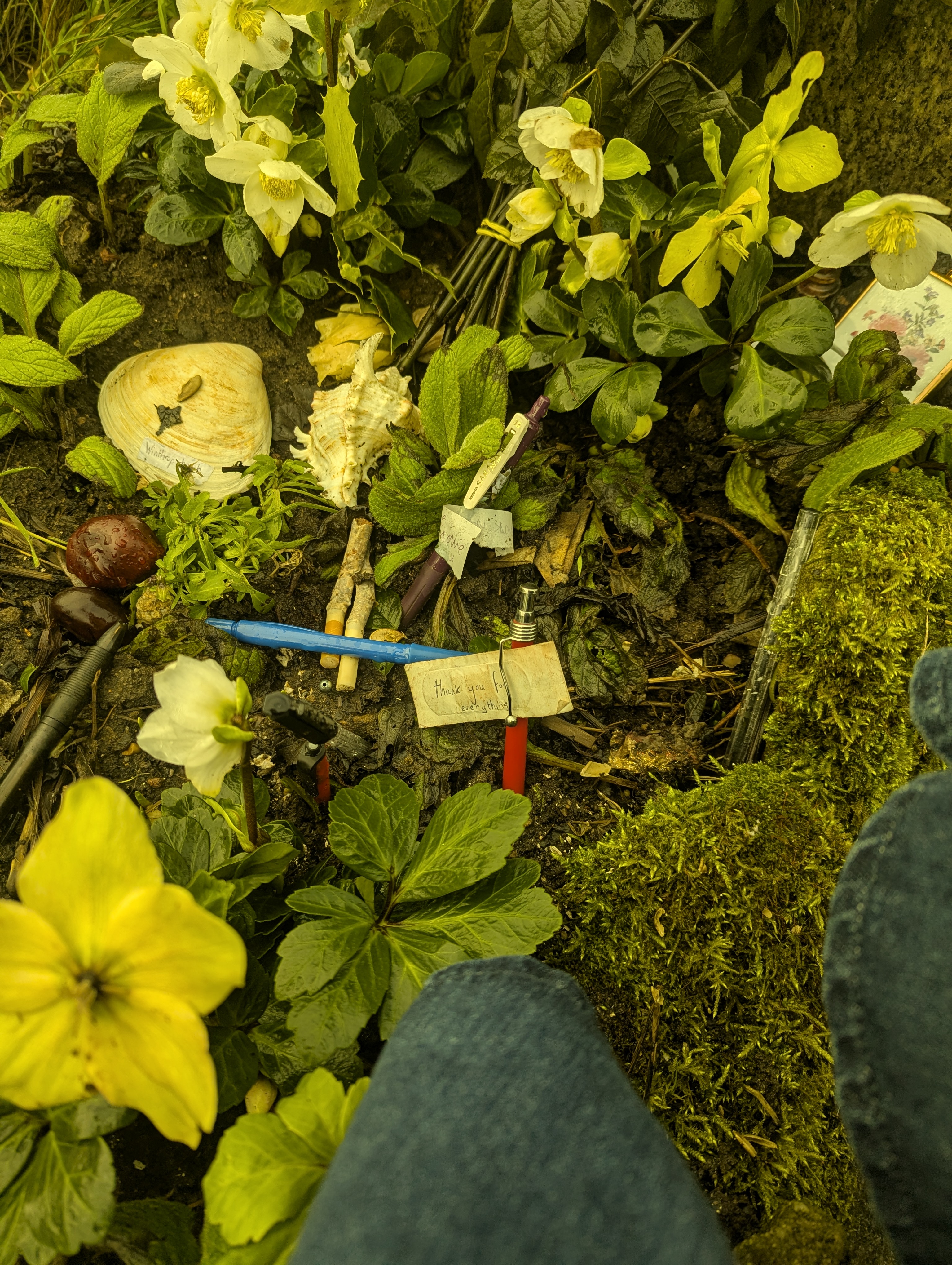
I turned away from the steep, tempting steps and instead kept on walking upwards. When I finally got to Heptonstall, a sheltered seated bus stop shone ahead like a mirage in very cold, winter desert. After sitting to catch my breath, I ate a Babybel, squished the red wax into my breast pocket with icy fingers, sipped some water from my flask and wandered down a winding cobblestone path towards the graveyard. I left a red pen for Sylvia. I wrote ‘thank you for everything’ on the wrappings of a peeling plaster, because I had left my notebook at home. I wrapped the plaster around the pen and pressed it into the earth alongside the many others. A home of pennies were scattered across the top of her tomb. As I added one to it, I felt a safety with her, if only for a moment. I felt a bit lighter, a bit like she was cradling me.
My life in Animal Crossing terms: An Ode to SunnyGo.
12 Aug 2025
Animal Crossing Wild World was the first "proper" video game I ever bought with my own money - and I bought it all by chance. I got it alongside the very first edition pink Nintendo DS back in March 2005. It was my 8th birthday. I saved up for ages and paid in mostly pound coins! I remember seeing the game in the shop and having no idea what it was, but the art on the game box was simply mesmerising. I vividly remember being transfixed by a rich dark green and brown globe dotted with little houses, animals and flowers. It had a pink and dark blue pixelated sky with little flashing stars in the distance. My little mind decided upon it, and I convinced my Dad to get the bundle that came with Wild World AND Nintendogs, even though it was way out of my price range. He wasn't happy, but it was worth it.
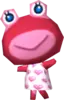
The second I booted up the game, there was just something about it that sucked me right in. The richness of the opening tune, the little pitpats of the players feet trundling along the grass. It was a place to get lost within the pixelated metaphor of it all. It felt magical and I became lost within it. I called my town SunnyGo. It grew pears and had a forked river with three seperate sections. I designed a little golden yellow flag for it. Just a giant "S" & "G". My favourite character became Puddles, a peppy pink frog with lovely style furniture.
I remember playing Nintendogs first and that had a save button in game - so I figured thats how ALL games must save. However, when I went to turn Animal Crossing off for the first time, it didn't have a save feature like Nintendogs did! I didn't realise you had to press "start" to save. I remember Resetti the mole coming to my town and being so scared!

During the summer of 2005, I played Animal Crossing multiplayer with my childhood friend Ellie at our family caravan site. I was 8 and she was 6. Our DS's still connected, even while we were under the covers in our prospective caravans - a few metres away from each other - with just a couple sheets of tin and a patch of grass to seperate us. That summer was filled with animal crossing, bicycle riding, pictochat, jumping over sanddunes on the beach, collecting shells (pixelated AND real), ice-cream, farm animal petting and getting stuck in quicksand.
When I showed the game to adults so excitedly, none of them seemed understand it. They always asked me what the "point" of the game was. They were expecting me to relay some rules back to them like you would for a more traditional game. When you're 8 and you try and explain that "you run around, plant things, decorate your house and make friends with the animals", it was confusing as to why the adults around me still viewed this as "not having a point". I didn't get why they didn't get it. But I got it. When you're a child, you don't question point or purpose, you just follow joy. Animal Crossing was a safe wild world for me.
Christmas 2008, I was 11. I got Animal Crossing: City Folk on the Wii! I was so excited to play it, that after Christmas Dinner, I had set up the console in my Grandma's conservatory on her giant cube shaped TV. I called my town SunnyGo again, but this time I had peach trees. I was incredibly excited, as I hated having pears. I remember thinking they were an ugly fruit.
When I got Animal Crossing: New Leaf for the 3DS in 2012, I was 15. I got the Limited Edition Animal Crossing 3DS to go alongside it. It was white, with pretty little Nook Leaves and apples embossed on the lid. By that point I was a teenager and somewhat rejecting my childhood, so I didn't call my Town SunnyGo. Instead, I named it "Peachy". You guessed it, I had peach trees again.
When Animal Crossing New Horizons came out in March 2020, I was 22. I was insanely excited and preordered it to come with a tote bag and a badge. I was planning to go to the midnight release at the GAME shop...but then COVID hit. Instead, I downloaded it onto my switch at midnight and played it on the floor of my shared accommodation that I was soon due to move out of. It once again became my idyllic childhood escape from the pain of everything. And my pear tree'd town, once again, was named Sunny Go.
To the Orchard I haven't grown yet
5 July 2025
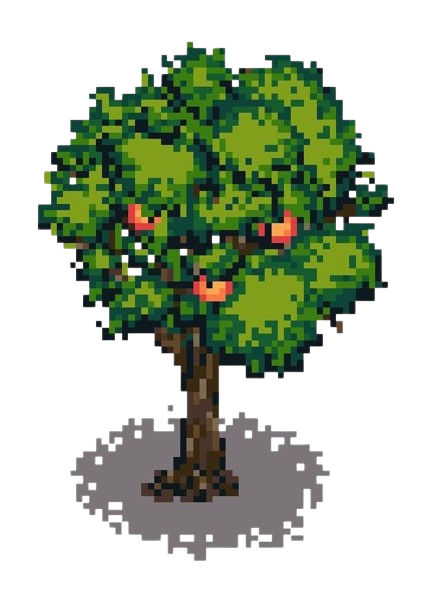
So I'm lying here in tears over Disney's Melody Time short: Johnny Appleseed. I'm not American, nor familiar with American folklore, so if you haven't seen it, it's about a run of the mill man who plants apples trees. With only his courage, a pot to cook out of and a humble bag of seeds, he traverses the land with dedication and simplicity - planting his trees wherever he goes. Over the many years, the fruits of his labour bring prosperity and unity in the form of a humble apple pie.
Something as small as steadily planting apple seeds over time, with fear-bounded courage, without the surety of success - in time - casts a shadow. The importance of that shadow is something I have sat upon. I really have begun to ignore what I once hoped to cast. Yet, if I could slip my shadow off entirely like a coat - unhook its threads - it would still be there. In a pile - on the floor next to, but not in my wardrobe - a familial reminder of my core. The spriteliness of me has faded, but it's a hope I cannot shake off. I submerge my dreams in distance, so the lip of me feels safe.
But the lip of me is lapping. In between the depths of distance, I'm choking on the blips and flips of the waters I created to soften the blow. As I look up, the apple tree orchards which cloud the sky have become clasped in the waves I so desperately tread to stay afloat. As the apple bobs, I have begun to sink.
Yet something so small, possibly as inconsequential as a pip, brings me back up momentarily to the surface. In these few gracious seconds, no longer shackled by the waters of distance, I am now drowned by fear. In this fleeting breath, a short bit with the sun, this is where I can see that my seed has promise. A seed is only as inconsequential as the means it has to grow. A seed I have not watered, but flooded with distance.
Yet what anchor to reality does this seed represent? Of my own fruition, what can I begin to grow? Have I sown any seeds at all? I have become so swept up with the dreams I have drowned in, that I have conveniently misplaced what my pursuit was, or even what I want it to be. In reality, I just don't want to face it. It is lost in a pile of rotting apples, and I am in the ocean.
To face the seed as a meagre seed. To turn it over in my hands. To plant it softly, in the cold, tumultuous earth. To spend a lifetime watering it, pruning it, coaxing it, without the assurance it will grow. To start at the beginning — without the security of success or ego — is what makes the sea of distance so alluring. Yet, the anchor I seek, is out on the shore. It's heavy, but glistens like the peel of a juicy plucked apple. The anchor that can drown me, is at the bottom of the ocean. A place where the sun can't reach. Where I cannot cast my shadow. A place where I cannot plant my seed.
I love learning: geekatron 5000
12 May 2025
A joy of life is the realisation or reminder of the amount I still don't know, seek to know, never know, or may ever know in the application of my learnt knowledge across a lifetime.
Yesterday, a doctor prescribed me using a medicalised term: supersede.
I didn't know the word, but once understanding its definition, I've proceeded to now see it used in a multitude of places.
Over the course of a few short days:
- A doctor friend stated it during a murder mystery dinner.
- It came up in the dialogue of a video game.
- I caught it uttered by the passing of a stranger in the middle of the street.
Each application stuck out like the pain of a sore thumb. Without another’s empathy - only I can feel it.
While the example is only a word, it sticks out with the illuminated bias of my own recent learning.
I'm simply noticing the world around me with the lens of knowledge I hold — and only hold.
That which is unknown, while physically present, is invisible to the beholder of knowing.
We are blinded by that which we are unable to see.
Being aware of potential that expands further than what is shown to be your version of truth brings a joyful human questioning of another’s experience.
What is my purpose / what is the point:
- To seek to eternally know more is a joy that’s enough.
- Every other has something known that I do not.
- It's my duty to learn more.
- They don't owe me their story.
- I can only seek it.